A few years ago, I was helping a contractor review his website. It was professionally designed, loaded quickly, and had everything you’d expect to see. There were testimonials, project galleries, service pages, and a prominent “Request a Quote” button in the header.
He asked me a simple question.
“If my website looks this good, why isn’t it generating more leads?”
The answer wasn’t what he expected.
I didn’t think his website had a design problem.
I thought it had a timing problem.
Most contractor websites ask homeowners to make a decision long before they’re ready. Within seconds of landing on the site, visitors are encouraged to call, request a quote, or fill out a contact form. From the contractor’s perspective, that makes perfect sense. If someone is interested, why not invite them to get in touch?
The problem is that interest isn’t the same as confidence.
Most homeowners don’t visit a contractor’s website because they’ve already decided to hire someone. They visit because they’re trying to decide whether the project itself is worth pursuing. They’re looking for ideas, reassurance, and a clearer picture of what life might look like after the work is finished.
A contact form doesn’t help them answer those questions.
Homeowners Don’t Wake Up Wanting to Fill Out Forms
Think about the last time you made a significant purchase.
Maybe it was a vehicle. Maybe it was a vacation. Maybe it was a piece of furniture for your home.
You probably didn’t arrive at a website thinking, “I can’t wait to submit my contact information.” You explored. You compared options. You imagined yourself owning the product before you ever spoke to a salesperson.
Home improvement projects are no different.
When someone starts thinking about a new patio, a backyard renovation, or a kitchen remodel, they’re trying to imagine a different version of their home. They’re picturing family dinners outside, children playing in the yard, or finally having enough room to entertain friends without feeling cramped.
Those emotions are what drive the decision.
The contact form simply arrives too early.
It’s asking for commitment before curiosity has had a chance to grow into confidence.
That’s why so many homeowners leave contractor websites without taking any action. It isn’t because they aren’t interested. It’s because they haven’t seen enough to feel certain.
Information Isn’t the Same as Confidence
Most contractor websites do a good job providing information.
They explain the company’s history, list the services they offer, display completed projects, and include customer reviews. Those things matter, and homeowners expect to find them.
But information rarely creates confidence on its own.
Imagine you’re considering adding a deck to your home. You browse through twenty beautiful project photos. Every one of them looks professionally built.
Now ask yourself a simple question.
Did those photos help you picture your backyard?
Probably not.
You admired someone else’s project.
There’s a subtle but important difference between inspiration and certainty.
Homeowners don’t struggle because they can’t find examples of beautiful work. They struggle because they can’t confidently imagine that work on their own home.
That’s the gap most contractor websites never bridge.
The Best Websites Create Momentum
I’ve started thinking about contractor websites less as marketing tools and more as conversations.
A good conversation doesn’t begin with paperwork.
It begins with curiosity.
The best salespeople understand this instinctively. They ask questions before they give answers. They spend more time understanding the customer’s goals than talking about themselves. By the time they discuss pricing, the customer already believes they’re moving toward the right solution.
Your website can create that same experience.
Instead of immediately asking visitors to fill out a form, give them a reason to stay. Help them explore ideas. Answer questions they haven’t quite figured out how to ask. Make it easier for them to imagine what success looks like.
As homeowners become more engaged, something interesting happens.
Submitting their contact information no longer feels like a commitment.
It feels like progress.
That’s a very different emotional experience.
Replace Forms With Experiences
I’ve come to believe that the future of contractor websites won’t be defined by better contact forms.
It will be defined by better experiences.
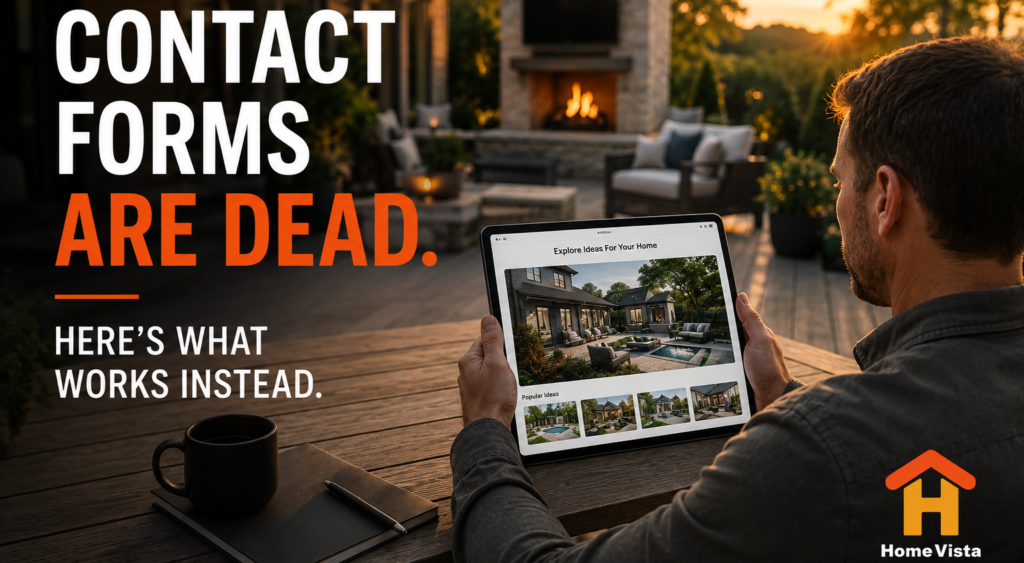
Imagine visiting a contractor’s website and being invited to upload a photo of your home instead of immediately requesting a quote.
Imagine seeing realistic concepts based on your own property instead of scrolling through galleries of someone else’s backyard.
Imagine exploring ideas, comparing styles, and beginning to picture your family’s future before anyone asks for your email address.
Now the conversation has changed.
The homeowner isn’t filling out a form because a website asked them to.
They’re continuing an experience they’ve already invested in.
That’s a much stronger reason to start a conversation.
People naturally value things they’ve spent time creating. The more involved homeowners become in imagining their future project, the more emotionally invested they become in seeing it become reality.
The lead isn’t being captured.
It’s being earned.
A Different Way to Think About Lead Generation
When we started building HomeVista, we weren’t trying to replace contact forms.
We were trying to answer a different question.
What if homeowners arrived at a contractor’s website and immediately began exploring possibilities instead of being asked for information?
What if the website itself helped build confidence before the first phone call ever happened?
That question changed the way we thought about lead generation.
Instead of focusing on collecting names and email addresses as quickly as possible, we started thinking about helping homeowners make better decisions. If someone uploads a photo of their home, experiments with different project ideas, and spends several minutes imagining the finished result, they’re no longer just another website visitor.
They’re emotionally invested.
By the time they decide to share their contact information, the conversation is completely different. They’re not asking, “Can you tell me more?”
They’re asking, “How do we make this happen?”
That’s a better place for every contractor to begin.
The Form Was Never the Goal
For years, we’ve treated contact forms as the finish line.
We measure conversion rates, celebrate form submissions, and optimize buttons hoping a different color or headline will encourage a few more people to click.
I think we’ve been measuring the wrong thing.
The form isn’t the goal.
Confidence is.
When homeowners become confident enough to imagine the finished project on their own home, reaching out becomes the obvious next step. The contact form doesn’t disappear. It simply moves to its proper place in the journey.
It’s no longer the beginning of the conversation.
It’s the natural conclusion of one.
That’s the future I think contractor websites should be moving toward, and it’s the idea that continues to shape everything we build at HomeVista. Not because forms are inherently bad, but because homeowners deserve an experience that helps them feel excited about what’s possible before asking them to make a decision.
The best websites won’t generate more leads because they ask for contact information more often.
They’ll generate better leads because they earn the conversation first.