If you ask most contractors why their website isn’t generating enough leads, you’ll usually hear the same answers.
“I probably need better SEO.”
“Maybe I should spend more on Google Ads.”
“I think I need a website redesign.”
Sometimes those things are true.
But after looking at hundreds of contractor websites, I’ve come to believe that most of them don’t have a traffic problem. They have an engagement problem.
Think about the last time you bought something expensive. Maybe it was a truck, a new television, or a family vacation. You probably didn’t land on the first website you found and immediately fill out a contact form. You researched, compared options, watched videos, and imagined yourself owning it. Somewhere during that process, your uncertainty turned into confidence.
Home improvement projects work exactly the same way. The only difference is that they’re even more emotional.
A kitchen remodel isn’t just new cabinets. A deck isn’t just lumber and composite boards. A pool isn’t just concrete and plumbing. People aren’t buying construction. They’re buying the life they imagine living after the construction is finished.
That’s an important distinction because most contractor websites completely ignore it.
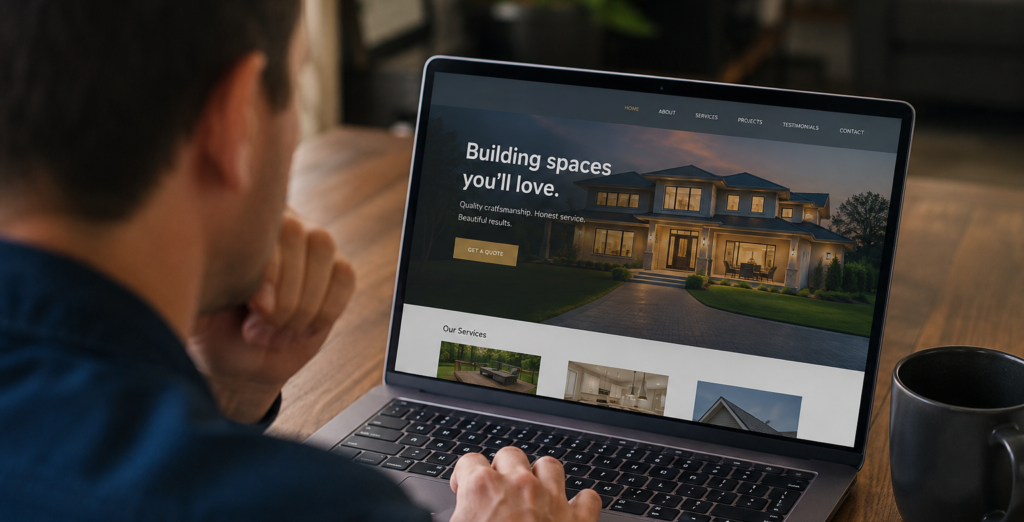
Spend ten minutes looking at contractor websites and you’ll notice something interesting. Most of them are almost identical. There’s a large hero image, a paragraph about being family-owned, a list of services, a gallery of finished projects, a few customer testimonials, and a button that says Request a Quote.
There’s nothing wrong with any of those things. They’re just expected.
If you replaced the company logo at the top of the page, there’s a good chance you wouldn’t know which contractor’s website you were looking at. Every site says roughly the same thing, follows the same layout, and asks homeowners to do the same thing.
That’s a problem because your website isn’t competing against the contractor across town. It’s competing against every digital experience your customer has ever had.
Think about how people use the internet today. They customize cars before walking into a dealership. They use augmented reality to see how furniture will look in their living room. They compare dozens of vacation rentals before booking one. They experiment with paint colors, kitchen layouts, and landscaping ideas long before they spend a dollar.
People are used to interacting with websites.
Then they land on a contractor’s website and suddenly the experience feels like it’s frozen in 2012. Read some text. Look at a gallery. Fill out a form. Wait for someone to call.
That’s not because contractors don’t care. It’s because most websites were designed to provide information instead of creating confidence. And confidence is what homeowners are really looking for.
Here’s something I’ve noticed over the years. When homeowners ask, “Can you give me an estimate?” that’s rarely the real question.
The real question is usually, “Can you help me picture this?”
Most people struggle to visualize a finished project. They know they want a bigger deck or a new patio. They know they want to remodel their kitchen or transform their backyard. What they don’t know is whether they’ll actually love the finished result.
That uncertainty is expensive. It causes people to ask for more quotes, delay decisions, and sometimes abandon the project altogether. Not because they can’t afford it, but because they can’t confidently picture the investment.
This is where most contractor websites unintentionally lose people.
The gallery is full of beautiful projects, but those projects belong to someone else. The homeowner isn’t trying to imagine living in someone else’s backyard. They’re trying to imagine walking out the back door of their home.
There’s a huge psychological difference between looking at inspiration and seeing possibility.
One inspires.
The other creates action.